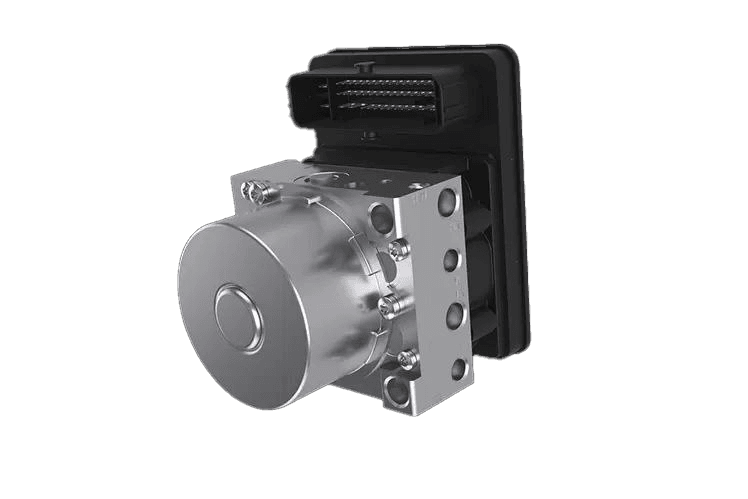
ABSAnti-lock Braking System
Prevents wheel lock-up while preserving steerability and braking stability on variable road surfaces.
Standards
- ISO 26262 development path
- ECE R13-H aligned
- ABS/EBD stack
- Continuous self-diagnostics
System overview
Anti-lock Braking Systems (ABS) represent a critical advancement in automotive safety, designed to prevent wheel lock-up during braking while optimizing vehicle control and stopping distances. This technology automatically modulates braking force across all four wheels, with particular attention to preventing rear-wheel lock-up first. The system operates in three modes—pressure increase, hold, and reduction—using solenoid valves to independently regulate each wheel’s brake pressure. By monitoring wheel deceleration rates, ABS predicts impending lock-up and cyclically releases/reapplies pressure to maintain traction, preserving stability and steering control while adapting to variable road friction such as ice and wet surfaces.
Independent per-wheel pressure modulation via solenoid valves
Steering control and obstacle avoidance retained under full braking
Adaptive performance on ice, wet, and asymmetric-friction surfaces
Self-monitoring with fail-safe reversion to conventional braking
Technical profile
Capabilities and technical values are program-dependent and must be confirmed against the applicable OEM requirements, vehicle architecture and validation plan.
Problems it solves
- Solves loss of steering and stability when wheels lock during hard braking.
- Reduces stopping distance on low-friction and split-friction surfaces.
- Mitigates yaw motion so the driver can correct the vehicle path.
Typical applications
- Passenger vehicles operating across wet, dry, and icy road conditions.
- Light commercial vehicles requiring stable emergency braking with load changes.
- Platforms building an ABS/EBD/ESC safety stack on a shared hydraulic base.
Technical profile
- Control modes
- Pressure increase, hold, and reduction per wheel
- Sensing
- Wheel-speed sensors with deceleration and slip estimation
- Functions
- EBD, hydroplaning detection, and uneven-terrain compensation
- Safety
- Continuous self-check with driver warning and fail-safe fallback
Partner with ATI
Bring this system to your platform
Our engineering team supports integration, calibration and validation — from prototype to series production.
Products
Explore other ATI products
A connected portfolio of vehicle motion and control systems.