One architecture for motion, safety and energy
Seven modules working under a shared decision layer — from environment perception to actuator.
Intelligent vehicle motion, safety and energy control
The ATI platform is a single architecture for motion, braking, steering, environment perception, energy management, BMS and vehicle communications — letting an OEM source a set of key systems from one coordinated architecture instead of several independent suppliers.
That coordination holds at hardware level, software level, network, calibration and test, and applies to passenger cars, light commercial vehicles, urban fleets, BEV, HEV and REV platforms.
- ESC Plus
Stability control, intelligent braking, ABS, TCS, EBD, DYC and the Plus function set
- EHB / IEMB
Engine-independent brake pressure, ready for AEB and regenerative braking
- EPS
Electric steering, intelligent assist, ready for LKA and Lane Centering
- ADAS
Environment perception via mono camera and 77GHz radar, producing warnings or control requests
- SCU / VMCS
Motion and energy control across BEV/HEV/REV and powertrain coordination
- BMS
Battery management, cell monitoring, protection, SOC/SOH and data exchange with the SCU
- Connected / WTM
Fleet communications, monitoring, data logging, connected services and 4G infrastructure
Seven modules, one vehicle
Select a module to see where it sits on the vehicle and what it does in the perception → decision → control → actuator chain.
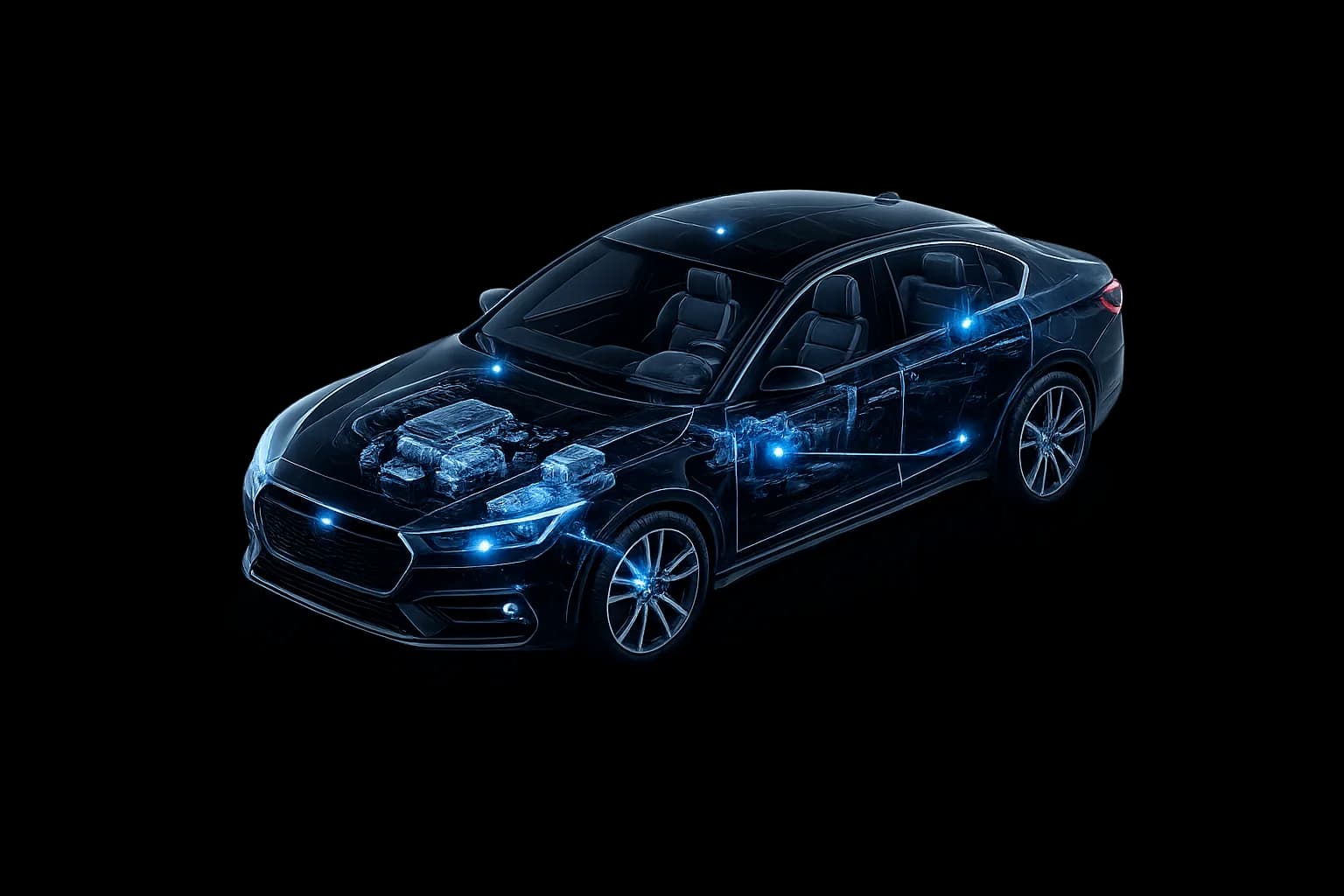
One architecture, not a set of parts
From environment perception and central arbitration through to brake pressure generation and path correction, the ATI modules work under one coordinated architecture. Select a module to see its position and its role.
- Years of experience
- +15
- Successful projects
- +50
- Advanced products
- 7
- Local design & manufacturing
- 90%
- ISO 26262 development path
- ISO 26262
- OEM & industry partners
- +12
Four layers, one command path
Sensor and ECU data is analysed coherently, and control commands reach the braking, steering, powertrain and energy subsystems along defined paths.
Perception layer
PerceptionVehicle state, path, obstacles, stability and energy are derived from the combined sensor set.
Components- 77GHz radar
- Mono camera
- ESC sensors
- Steering sensor
- BMS and HV data
OutputVehicle state, path, obstacle, stability and energy detection
Decision layer
DecisionHazard is identified and the braking, steering or torque decision is taken alongside energy management and fail-safe handling.
Components- ADAS ECU
- SCU
- ESC/EHB/EPS algorithms
OutputBraking, steering or torque decision, energy management and fail-safe
Control layer
ControlControl commands are executed smoothly and safely while preserving driving feel.
Components- Brake pressure control
- Steering torque control
- Motor control
- Charge and contactor control
OutputSmooth, safe execution of control commands
Actuator layer
ActuatorVehicle behaviour physically changes and energy is managed.
Components- EHB
- Brake hydraulics
- EPS
- Motor and inverter
- HV, charger and contactors
OutputReal change in vehicle behaviour and energy management
One collision hazard, five modules, one arbitration
In a collision-hazard scenario the ATI modules act under one coordinated architecture — something a combination of independent suppliers cannot guarantee.
- ADAS+0 ms
Target detection
ADAS fuses mono camera and 77GHz radar data to identify the target and the collision hazard.
- SCU / VMCS+40 ms
Decision and arbitration
The SCU arbitrates the requests and trims motor torque and energy draw to match the intervention.
- EHB / IEMB+90 ms
Brake pressure build
The EHB builds the required brake pressure in a short time, independently of the engine.
- ESC Plus+140 ms
Stability hold
ESC Plus applies brake-force distribution and yaw torque control to prevent instability.
- EPS+190 ms
Path correction
The EPS applies overlay torque to the steering for path correction where needed.
Event sequence — showing order and relative spacing of the steps · 0–240 ms
Seven modules, one architecture
Each module can be supplied on its own, and together they form a complete motion, safety and energy control platform.
- ESC Plus
Electronic stability and intelligent braking
The backbone of longitudinal and lateral stability
Prevents wheel lock under hard braking, drive-wheel spin, oversteer, understeer and vehicle instability in critical conditions, and integrates with EHB, EPS, ADAS and the SCU.
Layer: Control layer12 functionsTechnical detail - EHB / IEMB
Electro-hydraulic brake booster
Replacing the conventional vacuum booster
Enables brake pressure generation independently of the engine — essential for electric and hybrid vehicles, downsized engines and AEB systems.
Layer: Actuator layerTechnical detail - EPS
Electric power steering
The actuation layer for ADAS steering functions
Provides intelligent assist torque at the steering wheel, with steering feel tunable by vehicle speed, drive mode and OEM policy.
Layer: Actuator layerTechnical detail - ADAS
Advanced driver assistance
Front mono camera and 77GHz radar
Combines a front mono camera and a front 77GHz millimetre-wave radar to identify and analyse the road environment, warning the driver or intervening through ESC, EHB, EPS and the SCU.
Layer: Perception layer6 functionsTechnical detail - SCU / VMCS
Supervisory motion and energy control unit
The central controller in BEV, HEV and REV
Receives data from BMS, ESC, EHB, EPS, ADAS and the powertrain, and executes torque, energy, charging, safety and range strategies.
Layer: Decision layer1 functionsTechnical detail - BMS
Battery management system
Battery monitoring, protection and state estimation
Responsible for monitoring, protection, state estimation, safety management and data exchange with the SCU and other vehicle controllers. The BMS is designed and manufactured by ATI; battery pack design and manufacture is carried out by Napco.
Layer: Decision layerTechnical detail - Connected / WTM
Connected vehicle platform and WTM
4G communications and fleet services
Built around 4G communications, fleet monitoring, operational data logging and vehicle-state analysis, supplying operational data for aftersales, behaviour analysis and calibration improvement.
Layer: Perception layerTechnical detail