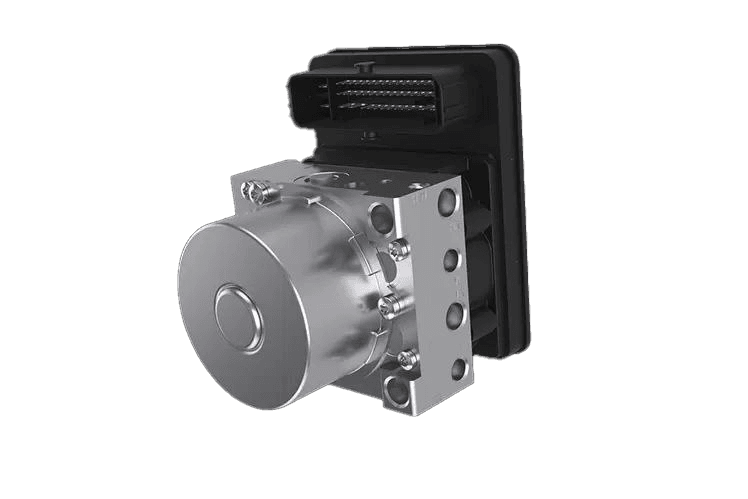
AWBAutomatic Warning Brake
Adds warning-level braking cues before stronger intervention is required.
Standards
- ISO 26262 development path
- CAN-integrated control
- ESC/ABS interface
- Program-specific validation
System overview
Automatic Warning Brake (AWB) is a warning-first collision-mitigation function. Perception inputs assess time to collision, issue visual, audible, or haptic alerts, and coordinate brake preparation with ESC and ABS before stronger intervention is required. The exact sensor set, warning thresholds, operating envelope, and hydraulic preparation targets are calibrated and validated for each OEM vehicle program.
Radar, camera, and ultrasonic risk sensing
Visual, audible, and haptic driver warnings
Brake-line pre-fill and pad positioning for readiness
Program-calibrated warning and preparation thresholds
Technical profile
Capabilities and technical values are program-dependent and must be confirmed against the applicable OEM requirements, vehicle architecture and validation plan.
Problems it solves
- Solves late driver awareness before a potential collision.
- Prepares the brake system so response is faster if needed.
- Coordinates warning and preparation without claiming full AEB intervention.
Typical applications
- ADAS platforms wanting warning-first collision mitigation.
- Vehicles pairing AWB with FCW and AEB.
- Programs targeting defined OEM or assessment protocols.
Technical profile
- Sensing
- 77 GHz radar, mono/stereo cameras, ultrasonic sensors
- Phases
- Risk assessment, driver warning, brake preparation
- Preparation
- Program-calibrated hydraulic pre-fill and pad positioning
- Integration
- CAN network with ESC and ABS, often paired with FCW
Partner with ATI
Bring this system to your platform
Our engineering team supports integration, calibration and validation — from prototype to series production.
Products
Explore other ATI products
A connected portfolio of vehicle motion and control systems.